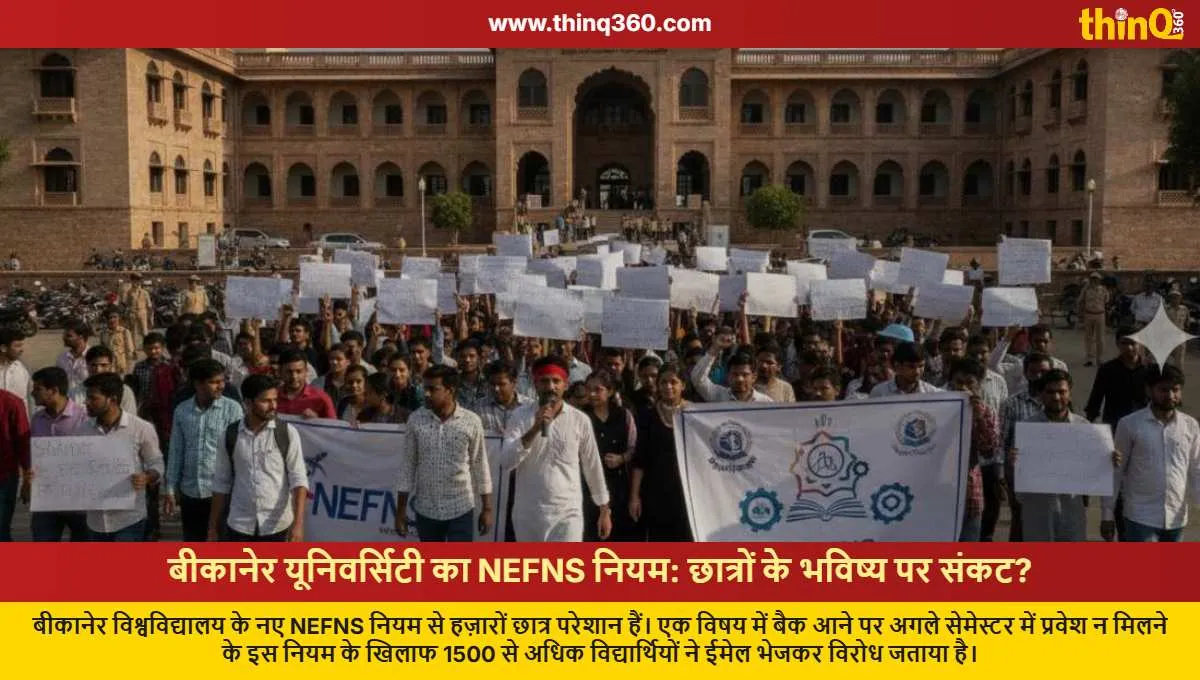
NEFNS Rule: No admission to the next semester if there is a backlog in any one subject.
Over 1500 students have protested by sending emails to the university administration.
Demand: An opportunity to clear all pending subjects by the sixth semester.
Students have warned of a larger movement if a positive decision is not made.
Bikaner | There is significant outrage among students regarding the new semester rule at Maharaja Ganga Singh University (MGSU), Bikaner. Under the university's newly implemented NEFNS (Not Eligible For Next Semester) rule, any student with a backlog in an odd semester will not be given admission to the next semester.
What is the NEFNS rule and why is it being protested?
This new provision by the university has put the future of thousands of students in question. According to the rule, if a student has a backlog in any subject in the first, third, or fifth semester, they will become ineligible for the next even semester (second, fourth, or sixth).
Students argue that this rule is impractical and unjust. Losing a whole six months or a year due to failure in one or two subjects could be a major setback for their careers.
Under the leadership of student leader Arjun Panchariya, more than 1500 students have sent a collective email to the university administration regarding this issue.
Their primary demand is the immediate withdrawal of the NEFNS rule. Students should be allowed to continue their studies in the next semester.
Students say, "They should be given the opportunity to clear all pending subjects by the sixth semester. The purpose of the education system should be to provide opportunities, not to close doors over a single mistake."
Warning to Administration, Students on the Path of Agitation
The students have clarified that their protest is currently completely peaceful and democratic. The email campaign is a step in this direction.
However, they have also warned that if the university administration ignores student interests and fails to make a positive decision, this protest could escalate into a larger student movement.
For now, all eyes are on the university administration's next move. The student community is hopeful that their demands will be considered sympathetically.
This decision will not only affect the immediate future of these students but will also be a test of the university's student-friendly policies. It remains to be seen whether the administration provides relief to the students or stands firm on the rule.

 जोगेन्द्र सिंह शेखावत